

JAMHUURIYADDA FEDERAALKA SOOMAALIYA МAХKAMADDA SARE EE FEDERAALKА QAYBTA DOORASHADA MAGACA DADWEYNAHA SOOMAALIYEED XUKUN
Oo uu kaalinayo Maxamed Faarax Jimcaale, waxa ay 17, 18 iyo 19 Agoosto 2026 u fadhiisatay garmaqalka duridda doorashooyinka ee galka sumaddiisu tahay MSF/DD/1/2026, taas oo u dhaxaysa dhinacyada hoos ku xusan: A. DHINACYADA 1) Urur Siyaasadeedka Dib-u-heshiisiinta iyo Horumarinta Towfiiq (Ururka), Qareenno: Sakariye Ismaaciil Nuur, Cali Xalane, Xasan Maxamed Muuse, Sadiiq Aadan Cali, Xuseen Cabdi Yuusuf, Xabiib Cali Jaamac, Mаxamed Xasan Cusmaan iyo Cabdullaahi Macallin Muxyidiin — DURE LID 2) Guddiga Madaxabannaan ee Doorashooyinka Qaranka iyo Soohdimaha (Guddiga), Qareenno: Cabdiqaadir Cusmaan Cabdisalaan iyo Cabdinuur Maxamed Yuusuf — LADURE
Hoose kala soo dag maqaalka:
Xukunka Maxkamadda Sare ee Doorashada Galmudug_0001-1-23
The Somalia Wire-Somalia’s Polycrisis – A Tipping Point?
Delegates from Somalia's influential Darood clan family are currently gathering in Nairobi, Kenya, for a crucial "pre-conference" planning session. Driven largely by clan chiefs, the meeting is designed to formulate a unified strategy and coordinate responses to ‘fundamental issues’ (arrimo masiiri ah) within Somalia, principally centre-periphery tensions and the future of federalism.
The anticipated culmination of these talks is a comprehensive Pan-Darood congress in Garowe. This development represents a rare and significant intervention, serving as a clear indicator of accelerating political polarisation and fragmentation. Although friction between Darood constituencies and the Federal Government of Somalia (FGS) is historically persistent, recent events in Puntland have acted as a catalyst for widespread discontent.
A growing perception within the community suggests that federal authorities in Mogadishu are actively seeking to engineer a violent subversion of President Sa'id Abdullah Deni’s elected administration. For both the regional leadership of Puntland and the broader Darood collective, this perceived federal interference represents a critical, non-negotiable red line. Deni prevails For the moment, Puntland President Sa'id Abdullah Deni has successfully held the line against Villa Somalia’s alleged orchestrated attempt to instigate an armed insurrection. In a swift pre-emptive response, pro-Deni forces neutralised a Puntland Security Force (PSF) faction that had openly aligned itself with federal interests and units of the federal forces.
This decisive outcome was largely engineered behind the scenes by senior Majerteen elders and politicians, including ex-President Mohammed Faroole. Despite their internal political grievances with Deni, the broader Majerteen Issue 971 | 19 August 2026 instinctively rallied behind their regional executive – a cohesive, defensive alignment that must have caught federal strategists completely off guard.
The PSF is no ordinary militia; it is an elite, American-trained counter-terrorism asset long overseen by the prominent Diyaano family. Consequently, a subsequent US agreement with Puntland over the strategic utilisation of Bosaaso reads as a quiet, calibrated American protest against Mogadishu’s heavy-handed machinations and the weaponisation of the PSF. While Deni has prevailed for now, the threat has not dissipated. The Deni camp remains convinced that Villa Somalia will launch fresh campaigns to fracture Puntland or possibly instigate fresh armed clashes along the fault lines of Gaalka’yo – a divided city that is also a historical flashpoint of interclan hostilities in the north.
Download the article below:
PDFIssue 971
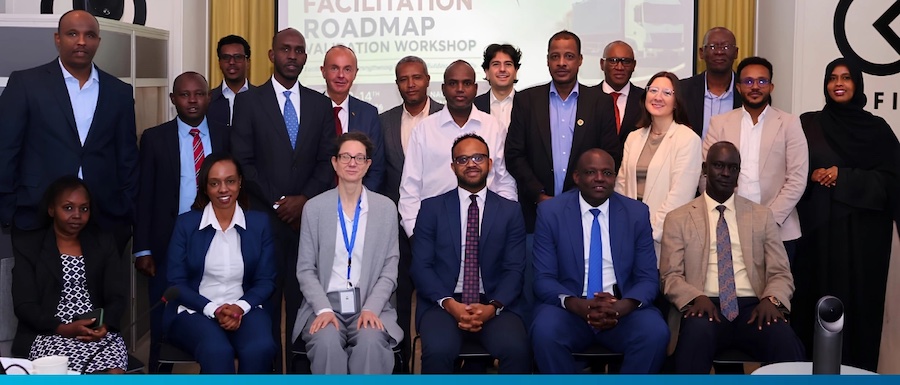
Five Horn of Africa countries meet to discuss a regional approach to trade facilitation
* Five Horn of Africa countries are validating a regional trade facilitation roadmap aimed at improving cross-border trade.
*
* The roadmap takes a bottom-up approach, building regional solutions around practical challenges identified through national consultations.
*
* Implementation will be crucial, as the initiative seeks to create a more connected trade system that enables the region to function as a single economic space.
High-ranking officials from the ministries of trade and finance from Djibouti, Ethiopia, Kenya, Somalia, and South Sudan are meeting in Nairobi today, 14 August, to discuss and validate the second edition of a regional trade facilitation roadmap. The roadmap is designed to address one of the Horn of Africa’s most persistent obstacles to economic integration: the difficulty of moving goods efficiently across borders.
The conference, which began yesterday, is coordinated by Liban Obsiye, Head of the Horn of Africa Initiative (HoAI) Secretariat, and the Nairobi branch of German development bank KfW. It focuses on a cycle of national consultations conducted across the five countries, bringing together public institutions and private-sector stakeholders.
Rather than imposing a uniform blueprint from the outside, the roadmap has sought to build a regional framework from the constraints and practical realities identified within each country.
This makes the approach unusual in the African integration landscape. Instead of following the traditional top-down pathway, in which regional commitments are negotiated first, and implementation is expected to follow, the HoAI is pursuing a bottom-up pathway, starting with problems identified on the ground and building regional solutions around them.
Read article…
Mocha: When the sea turns from a bridge of connection into an arena of conflict
Mocha is an ancient and historic Yemeni city located on Yemen’s western coast along the Red Sea. Administratively, it belongs to Taiz Governorate, while geographically and culturally it forms part of the Tihama region — the coastal strip stretching along the Red Sea from southwestern Saudi Arabia to the western shores of Yemen.
Geography has endowed Mocha with an exceptional location. It lies close to the Bab Al-Mandab Strait, one of the world’s most important maritime passages, and faces, across the African shore, the Horn of Africa — Djibouti in particular. From this strategic position, Mocha served for centuries as a maritime gateway linking Yemen with the Hijaz, Egypt, East Africa and India, and later with Europe and the wider world.
The Red Sea and Bab Al-Mandab were never merely geographical barriers separating Mocha from Djibouti. Rather, they were bridges of human, commercial and cultural interaction. Sailors, merchants and families moved across these waters, creating deep social and human bonds between the people of Yemen — including the inhabitants of Mocha — and the people of Djibouti and the Horn of Africa. To this day, the collective memory of the region retains abundant evidence of this human interconnection, which predates modern political borders by centuries.
Mocha reached the height of its prosperity during the 17th and 18th centuries, when it became one of the most renowned ports for exporting Yemeni coffee grown in the country’s highlands. European merchants came to know the coffee shipped from its port as “Mocha coffee” or “cafe Moka.
From there, the word mocha/moka entered languages around the world and became associated with coffee. Its meaning later evolved to refer to beverages combining coffee and chocolate. Thus, the name of Mocha remains present every day in cafes across the globe — a reminder of an era when this Yemeni city was a center of international trade and a gateway through which an authentic Yemeni product reached every corner of the world.
The painful irony, however, is that a city with such a remarkable heritage and strategic location did not receive, over recent decades, the development and attention it deserved. Its economic importance declined, while its considerable maritime, tourism and commercial potential remained largely untapped and far below what its history and location would warrant. In this respect, Mocha shares the fate of many parts of Yemen that have long suffered from inadequate development and the accumulation of successive crises.
Read article…
Saudi Arabia Announces New Red Sea Security Alliance With Five African Countries
Saudi Arabia had announced a new maritime security alliance involving five African countries to protect vital Red Sea and Gulf of Aden shipping routes The coalition had brought together Egypt, Sudan, Djibouti, Eritrea and Somalia alongside Saudi Arabia, Jordan and Yemen amid rising regional security concerns The partnership had focused on strengthening maritime defence cooperation as attacks on commercial vessels disrupted global trade routes.
Read more:
Suspected Somali pirates hijack Tanzanian-flagged tanker from Yemen
* A Tanzanian-flagged tanker, the MT ASANA, was seized by seven suspected Somali pirates after leaving Yemen, then forced toward Somalia’s Puntland region.
* Authorities and international naval forces have released no public details on the crew’s fate, injuries or nationalities amid information gaps as the hijacked vessel remains offshore.
* The attack is part of a resurgence in Somali piracy across the Gulf of Aden and western Indian Ocean, driven by persistent insecurity and reduced international patrols after years of calm.
MOGADISHU, Somalia — A Tanzanian-flagged tanker was hijacked by suspected Somali pirates off Yemen’s coast, security sources and local officials familiar with the incident said Sunday.
The commercial tanker has since been moved to waters off Somalia’s northeastern Bari region, according local officials.
The MT ASANA, a general tanker, was seized Friday after departing from Mukalla, Yemen, according to the sources. The vessel is now being held off the coast of Caluula in the Bari region of the semiautonomous state of Puntland.
Source: latimes
AL-SHABAAB’S EVOLUTION: STRATEGIC OR FORCED? An assessment of the group’s strategic, operational, and governance transformation and what drives it.
This study analyses the recent strategic and tactical evolution of Al‑Shabaab (AS), arguing that the group’s nearly two decades of survival stem less from raw military strength and more from its ability to adapt to shifting military, political, social, and economic conditions. Al‑Shabaab has moved away from an approach centred on holding territory and engaging in conventional battles towards a “long‑war” strategy focused on exhausting adversaries and exercising strategic patience. Over time, it has substantially upgraded its intelligence, communications, administrative, and financial capacities, exploiting technology, the internet, and mobile networks to coordinate and sustain its activities. Operationally, the group has shifted from frequent large scale, indiscriminate attacks on civilians to a greater focus on military and government targets, including critical infrastructure. Its operations are grounded in detailed intelligence gathering, long term planning, surprise, and the use of overwhelming force to seize a rapid tactical advantage. Beyond the battlefield, Al-Shabaab has consolidated its governance structures. It has developed systems for taxation, courts, education, healthcare, and water services, aiming to entrench its influence and secure a measure of public acquiescence. The group has also integrated clan elders and local religious scholars into its governance arrangements, establishing a council of clan elders and clerical councils to bridge the gap between itself and local communities and enhance its perceived legitimacy. In parallel, Al-Shabaab has established an opaque but significant governance structure, with FGS-recognised clan elders and representatives operating within government territory. The establishment of these councils mirrors the two pillars that have underpinned Somali social order for generations: customary authority and religious authority. The group’s relationship with local populations has thus evolved from one primarily based on fear to a more complex mix of coercion, service provision, ideological messaging, and social integration. This environment, together with chronic unemployment, poverty, and recurrent drought, has lowered recruitment barriers and facilitated the spread of al‑Shabaab’s narratives across communities.
Download the article below:
Al-Shabaab’s evolution
Clan conflict over land in Lower Shabelle leaves families destitute
(ERGO) – Families displaced by fighting over farmland in Somalia’s Lower Shabelle region are struggling to survive after fleeing their homes with nothing but the clothes they were wearing.
More than 50 families have sought refuge in Buufow-Ba’ad village since early May, according to local authorities. Most are facing acute shortages of food, clean water, and shelter after escaping violence around Beder village.
Among them is Kaltumo Farah Osman, who arrived in Buufow-Ba’ad on 15 May with her five children after fighting between two clan militias forced them to abandon their home
Kaltumo, a widow, said she spends her days knocking on doors asking residents to share whatever cooked food they can spare. When no one is able to help, she and her children go hungry.
“Our living conditions are extremely difficult. There is hardly any food here. I have five children to care for. Sometimes we find something to eat and sometimes we don’t. Today I have nothing to give them except to let them sleep hungry,” she told Radio Ergo.
She has been raising the children alone since her husband died from diabetes in 2024. They are sheltering under a few pieces of cloth tied together and held up by sticks.
“We have nowhere to sleep. I tied up these pieces of cloth, but if it rains there is nowhere to protect my children from the cold. I hardly sleep at night because I am constantly worried about them,” she said.
The family fled a three-room house toilet in Beder after armed men ordered residents to leave the land at the centre of the dispute. They escaped without any belongings, leaving behind eight goats that had provided them with milk and income. She assumes the animals have either been stolen or killed.
With no money for transport, Kaltumo and her children walked for 11 hours to reach Bufow-Ba’ad. Since arriving, she says they have received no humanitarian assistance.
Having never experienced displacement before, the family has struggled to adapt. Kaltumo has searched unsuccessfully for domestic work in Shalanbood and Marka, but says employers are reluctant to hire someone they do not know, while job opportunities are scarce.
She used to support the family through domestic work and occasional labour on nearby farms. Three of her children have had to drop out of their Koranic school since leaving Beder.
Dahir Abdi Shakur Hussein, who fled Beder at the end of May with his family of seven, faces similar hardship. Every morning he walks about five kilometres to Marka hoping to receive food from local residents. On good days he returns with about one kilogram of rice, which the family stretches over two days.
“We go around asking people in Marka for food. Sometimes someone gives us a kilo of sugar or rice, but many people have very little themselves. Our biggest problems are shelter and water. We have no plastic sheets to protect us if it rains, and we cannot afford to buy water,” Dahir told Radio Ergo.
The family previously relied on seasonal agricultural labour that earned Dahir about $4 a day working on leased farmland. Five of his children have also stopped attending Koranic school since the family fled.
He said residents of Beder were ordinary civilians, not combatants, who depended on farm labour after years of declining agricultural production:
“Fighting over farmland forced us to leave. Armed men told us to leave if we wanted to stay alive. We were not fighters -we were ordinary people trying to earn a living.”
This year Dahir had planned to cultivate a five-hectare family farm he inherited, hoping to rebuild after previous years of water shortages. Those plans ended when conflict forced the family to flee. The uncertainty is shared by many displaced households.
Fadumo Omar Haji, 60, and her family of six are now staying with another family in Buufow-Ba’ad. Her daughter collects firewood from nearby bushland, earning about 50 cents a day that can’t feed everyone.
Fadumo, who has suffered persistent headaches and ringing in her ears for the past two years, said her health has deteriorated further since displacement.
She used to earn $3 to $4 a day selling milk in Janale, about three kilometres from Beder. The family left behind the two-hectare farm that they had hoped to cultivate this season after recovering from previous years of water shortages.
Instead, irrigation canals were cut off by the fighting, ending any prospect of planting crops.
Source: reliefweb
Somalia closed an Iranian weapons door. Israel should not relax yet.
Analysis: Mogadishu signed fifteen maritime treaties and gave allied navies a new legal tool to choke the pipeline arming the Houthis; the tool leads to a coastline still run by clan militias and an al-Qaeda affiliate; Israel has been promised reliable partnerships before.
Last Saturday, Somalia's government signed fifteen international maritime treaties in a single ceremony. This marked the largest legal overhaul of the country's waters since independence in 1960. The announcement faded quickly from international headlines. It should not fade from the Israeli security conversation.
What Somalia signed connects directly to the Iranian supply chain that keeps Houthi missile crews operational. Whether the signature produces real results depends on questions Somalia has failed to answer for 65 years.
Source: ynetnews